



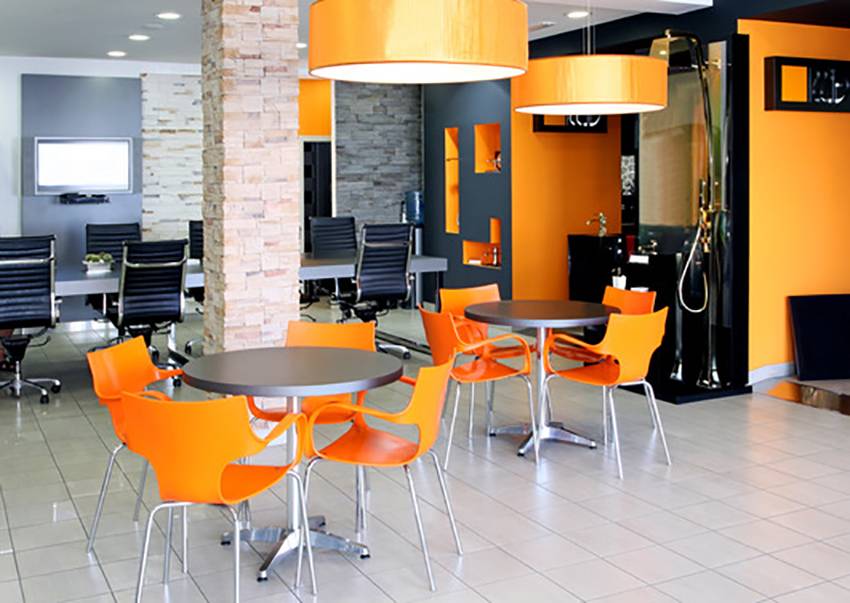
Many people may be sceptical about the idea that the colour of an office and its office furniture can have psychological effects on employees, let alone affect their productivity. As different office colours can influence the choice of furniture colours, this means that, in practice, the colour of office furniture is likely to matter a great deal.
For those who design offices, this kind of insight can leave them feeling either creatively constrained or inspired.
Simple ways to increase office productivity
Overall, this is something that should be encouraging. The fact that it may be possible to increase employee productivity with a simple coat of paint should be welcomed. Employers often spend vast amounts of money trying to make their employees more productive. Some offer their employees share options.
Others organise all kinds of corporate and business events. Most of these measures cost a company a great deal of money, especially compared with a few coats of paint. Choosing one office furniture range over another can make a real difference in many workplaces.
Choosing the right colours for your office and office furniture
The worst office colours
When most people think of office colours, they tend to picture white, grey and beige. It is unfortunate that these neutral shades are so common in offices around the world. They are all strongly associated with feelings of discouragement and low mood among office workers.
There is considerable debate over whether different groups of people react differently to colours. This certainly appears to be the case. Different colours mean different things in different cultures, for example. However, for many employees, colours such as beige, grey and white do not appear to promote happiness or productivity in the slightest.
Many male Western workers are similarly unproductive in orange or purple offices. It is unclear why this is the case, or why women seem to be less affected by these colours. However, many women may dislike them too. One way or another, many people in the office will not respond positively to purple, orange, white, beige or grey walls.
It stands to reason that office furniture in similar shades may be equally problematic. An ergonomic chair can benefit employees; there is no doubt about that. However, if that chair is grey, beige or white, as is often the case, its colour could be just as problematic as walls in similar shades.
The best office colours
It is true that many people like green and blue. These are the shades people would have seen most often in natural environments throughout human history. As a result, both colours are viewed positively in most cultures. Green office walls can feel welcoming. In fact, they may help employees feel more relaxed and energised at the same time. Looking at certain colours can literally be tiring. This is not an issue with green. People may not deplete their energy reserves as quickly when surrounded by green, making it one of the best colours for an office.
Many people feel calm in a blue office. They are also more likely to stay focused and see certain tasks through to completion. Blue is also a colour that most people like. Few people will object to a blue office, whether they are design professionals or employees themselves. Blue also works well with almost every other colour when it comes to office furniture; black office furniture, in particular, tends to complement blue office walls very well.
Red is certainly a colour that can energise many people. However, it may be better suited to office furniture than to the office walls themselves. People may end up looking at the walls more than at their work. Red may also leave them feeling somewhat distracted. It is a good way to highlight certain features, but may not be the best overall colour for office walls.
Yellow is a colour that appeals to many creative people. Many people also like light-coloured office walls. They may not be happy to give up all their white walls simply because there may be a correlation between white walls and a range of negative effects. Choosing yellow walls instead can work very well as a compromise. People can still enjoy light, stylish walls. However, they will have a colour that tends to make people feel happier and generally more enthusiastic about working. Yellow also looks excellent with darker office furniture. It should be easy to find furniture that complements yellow walls.
Some office wall colours may be controversial. Few people would want pink office walls, despite some evidence that pink may even have a calming effect on criminals. Nevertheless, adding subtle pink tones to the walls and office could still help without drawing too much attention to the colour itself.
Many people want to make office improvements that go beyond simply adding an ergonomic office chair. Changing the colour of an office, or choosing something different when it is time to refurbish, can help employees improve their work performance with little effort. Many people will love the new office colours. They will also show their appreciation for the new office in many subtle ways, including through their work performance.
Deja un comentario