



Operational guidePhased refurbishment6-minute read
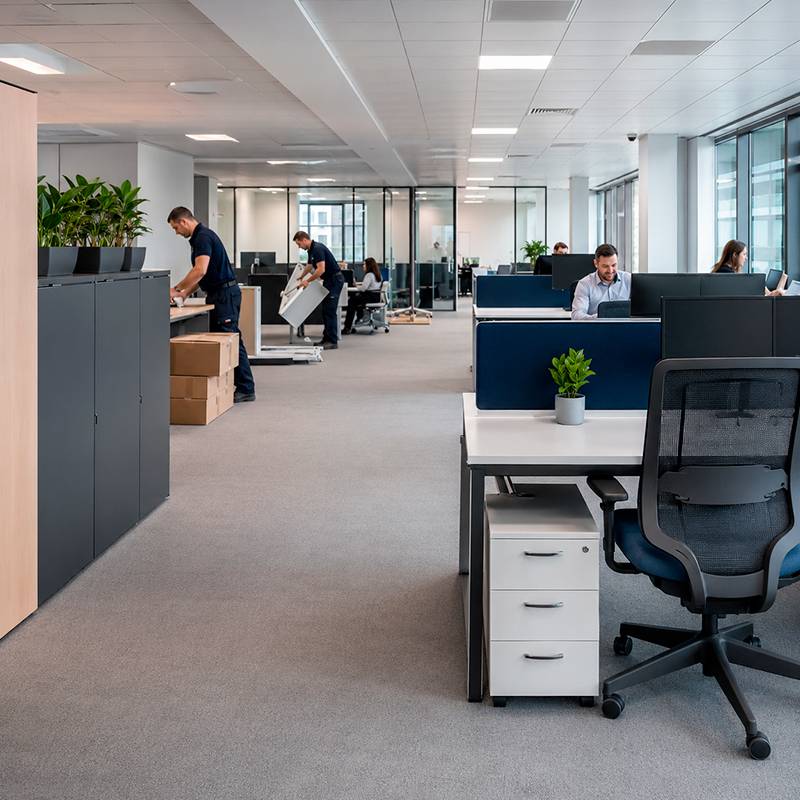
Refurbishing an office should not mean bringing business operations to a halt, improvising an internal move or leaving teams working among boxes, dismantled desks and out-of-service chairs.
The difference between buying furniture and refurbishing an office is that, once the project is complete, every workstation must be operational, ergonomic and ready for use.
For an organisation, the true cost of a poorly planned refurbishment lies not only in the furniture itself, but also in lost productivity, logistical disruption and the time employees spend without fully operational workstations. That is why an effective refurbishment should be managed as a corporate operation: assessment, planning, phasing, furniture preparation, installation, removal and final adjustments.
At FactoryOficina, we help companies, facility managers and procurement teams refurbish workplaces by combining professional refurbished furniture, remanufacturing, upholstery, new products and coordinated logistics. The objective is clear: reduce investment, maintain business continuity and improve the overall quality of the workspace.
Up to
−70%
below the original RRP of each item, with 10–15 years of remaining service life
50 workstations
96kg CO₂eq
compared with around 3,500 kg when fitted out with new furniture
Illescas
2,500m²
of showroom and stock space, enabling us to supply hundreds of identical workstations
01
The common mistake: treating refurbishment as a purchase
Many companies begin the process with a seemingly straightforward request: ‘we need 50 desks and 50 chairs’. However, this approach often overlooks far more important questions: how many workstations are actually used, which furniture can be retained, which chairs can be refurbished, which areas are now oversized and which teams cannot suspend their operations.
Buying without an assessment creates two problems:
An efficient refurbishment does not begin with a catalogue; it begins with an accurate picture of how the office is actually used.
02
Initial assessment: what to review before moving a single workstation
Before preparing a quotation, the office should be audited from an operations perspective: actual usage, ergonomics, circulation routes, storage, asset condition and logistical constraints. This stage determines what should be retained, refurbished or replaced.
Operational audit checklist
03
Phased plan: the safe way to refurbish 50 workstations
A phased refurbishment allows the company to remain operational while workstations are replaced, refurbished or reconfigured. The aim is to prevent the office from becoming a temporary warehouse and ensure teams retain their operational capacity.
-
Phase 01Assessment
Audit of workstations, existing furniture and building access.
Prevents unnecessary purchases and reduces operational risk
-
Phase 02Preparation
Remanufacturing, upholstery and logistical pre-assembly in Illescas: the heavy work takes place away from your office.
Minimises the time spent working at your premises
-
Phase 03Installation
Refurbishment by zone, department or time slot.
50critical workstations remain operational
-
Phase 04Removal
Removal of replaced furniture through the Sustainable Buyback programme.
80%less internal disruption
-
Phase 05Adjustments
Ergonomic review, issue resolution and final configuration.
50workstations ready for use
04
What to keep, refurbish or replace
The most cost-effective decision is not always to buy everything new. In many projects, the best solution combines refurbished office chairs, professional office desks, upholstery, new products and the selective removal of assets that are no longer fit for purpose.
| Item | Keep | Refurbish | Replace |
|---|---|---|---|
| Task chairs | If the mechanism and base are in good condition | Upholstery, foam, castors, armrests or gas lift | If there is damage, excessive play or poor ergonomics |
| Desks | If the dimensions and stability are suitable | Cleaning, adjustment, desktop or configuration | If they are incompatible with the cabling or layout |
| Cupboards | If capacity and security are sufficient | Keys, technical cleaning and adjustments | If they occupy space without serving a genuine need |
| Meeting rooms | If they meet current requirements | Chairs, tables and configuration | If a hybrid or collaborative format is required |
05
Frictionless logistics: when is delivery truly complete?
For a business, having furniture delivered to the kerb does not solve the problem. The refurbishment is complete only when every workstation has been installed, aligned with the space, inspected and made ready for use.
Selling furniture is not enough. We must deliver functional workstations without disrupting the company’s day-to-day operations.
FactoryOficina operating principle
This approach is particularly important for chair upholstery and reupholstered projects, where temporary replacement chairs allow work to be completed in batches without leaving employees without a workstation. It is also essential for expansions, office relocations and departmental reorganisations.
06
Practical example: refurbishing 50 workstations
Consider a company with 50 employees and a hybrid working model. It has worn chairs, reusable desks, excessive storage and several underused areas. The solution does not have to involve replacing everything: it can combine remanufacturing, premium refurbishment and reconfiguration.
30 chairs with professional upholstery, mechanical inspection and technical cleaning.
20 chairs with high-performance refurbished task chairs.
The suitable desks, while adjusting the layout and freeing up unused storage areas.
Zone by zone, keeping teams operational throughout the refurbishment.
Result
Lower investment than a 100% new furniture purchase, less internal disruption, improved ergonomics, a refreshed appearance and a lower environmental impact. The savings do not come from buying inferior products, but from making better decisions about what to keep, remanufacture and replace.
07
Refurbishing without disruption is a management decision
An office is not refurbished efficiently by buying more units, but by reducing disruption, making use of suitable assets and ensuring every workstation is operational again as quickly as possible.
FactoryOficina offers three product conditions, combining them with remanufacturing, new solutions and coordinated logistics to refurbish spaces with lower investment, less disruption and greater operational control:
Factory Rebuild
1-yearPremium warranty
Refurbished: previously used corporate furniture that has undergone a complete remanufacturing process.
Factory Selection
2-yearPremium warranty
Selection Premium: designer pieces with very limited previous use and selective refurbishment.
Factory New
3-yearPremium warranty
New: brand-new products supplied through official manufacturer distribution channels.
08
Deja un comentario