



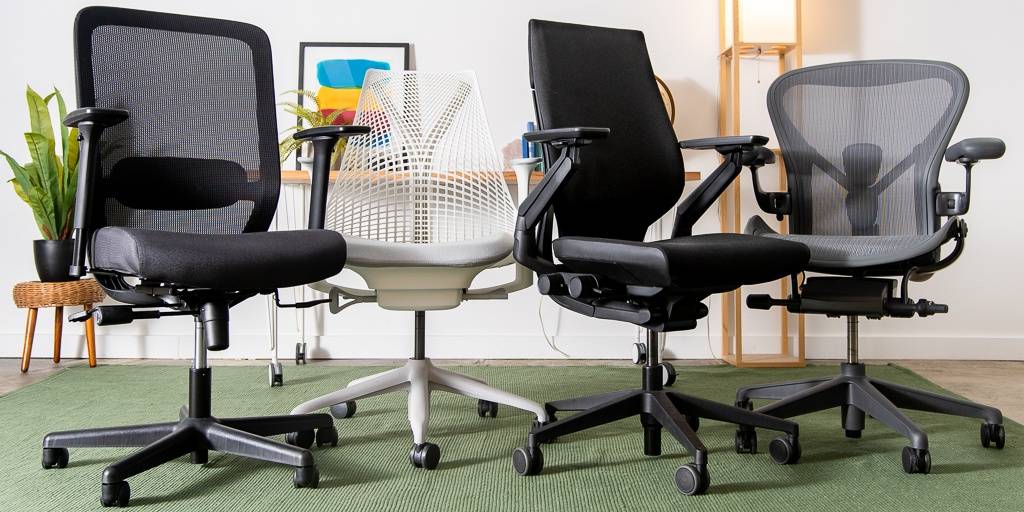
Although remote working has been gaining ground for several years, the coronavirus pandemic gave it an unexpected boost: without having planned for it, many people had to start working from home. In many cases, this situation will continue for quite some time, and for certain jobs it may even become permanent. So, while any living-room or dining-room chair may have served as a good temporary solution at first, it may now be time to invest in a good office chair that supports a correct sitting posture.
What makes an office chair ‘good’?
There are several factors to consider when making your choice. The market offers a very wide range of prices, from highly affordable models to premium designer seating that can cost well over 700 euros. Although there is no need to spend a fortune at an office furniture shop, it is not advisable to cut costs too much either, as this is an investment in your health. In the long term, a chair that fails to meet minimum requirements will come at a higher cost, both financially and, above all, in terms of health. More than a third of workers in Spain (37% of the total) believe that their work has a negative impact on their health. Back pain (reported by 46% of those affected) is the most common problem, followed by muscle pain in the shoulders, neck, arms and hands (45%) and general fatigue (45%). These figures, taken from the latest National Survey of Working Conditions, cover all working environments, not only those involving several hours a day in front of a computer. However, failing to take the necessary measures regarding the seat could cause these figures to rise.
Key considerations when choosing the right office chair
Just as no two people are alike, there can be no single ‘ideal’ desk chair whose shape and dimensions suit everyone. It is therefore essential for its components to be adjustable, allowing each user to adapt it to their own needs. This makes it easier to comply with the ‘minimum health and safety requirements for work with equipment incorporating display screens’, established by Royal Decree 488/1997 of 14 April. When choosing the most suitable chair, the following five elements should be considered:
1. The seat should be adjustable to suit the length of your legs
It is essential that users can adjust the height of the seat so that their feet rest on the floor and their legs are bent at right angles: the lower legs should be vertical and the thighs horizontal. The ‘depth’ of the seat must also be adjustable, meaning the distance between the backrest and the front edge, where the legs bend. This edge should be rounded and slope downwards so that the backs of the knees are not compressed and blood circulation is not restricted. The seat should also be wide enough (around 40–50 centimetres) to leave sufficient space at the sides for freedom of movement.
2. Backrest: the right angle and proper lumbar support
The backrest of the seat should be adjustable in several ways. The most important factor is the reclining angle, which should allow the torso to remain upright. The height of the backrest should allow the back of the neck to rest against it and, where possible, it should include a headrest: a small raised section that performs a similar function to a pillow when lying down. It should also ‘have a gentle prominence to support the lumbar region’, as stated in the ‘Basic guidance for workers using visual display screens’, published by the Ministry of Labour. It should, of course, be as wide as the seat, or at least wide enough for the entire back to rest against its surface.
3. Armrests: not essential, but highly beneficial
Armrests are optional but highly recommended. Many chair models allow their height, width and even angle to be adjusted. The key is for users to feel comfortable and for their arms, like their legs, to form right angles: the upper arms should be vertical and the forearms horizontal. They must also be sturdy enough to support the weight of someone leaning on them when standing up and, where possible, should not prevent the chair from being stored close to the desk.
4. The importance of a stable base
Chairs with five points of contact provide the greatest stability. Chairs with castors are also recommended, as they make it easier to move around, which is particularly important in a large workspace. To prevent unintended movement, the material used for the castors should also be suitable for the type of flooring.
5. Simple, safe adjustment mechanisms
Adjustment mechanisms should ideally be easy for users to operate while seated. The system should also include safety locks to prevent unintended changes. A sudden, unexpected change in posture can cause painful injuries.
Other factors to consider
Although office furniture should ideally be adjusted to suit the individual user, a footrest may sometimes be necessary: for example, if the desk is too high and cannot be replaced, or for shorter users. In such cases, it is an essential accessory. To prevent pain and injury, it is also important to avoid working solely on a laptop for extended periods.
The reason is very simple: the correct positions for the screen and the user’s arms are incompatible. Why? Because the screen should be at least 40 centimetres from the user’s face, with its top edge at eye level or a few centimetres below. If these guidelines are followed, it is impossible for the laptop keyboard to be positioned correctly for use with the arms at right angles.
Fortunately, this problem has a simple and affordable solution: using an external keyboard. This allows the computer to be positioned so that the screen is at the correct height and distance, while the keyboard and mouse can be placed separately to ensure the arms remain in the correct position.
Deja un comentario